
how to train a dog not to jump starts with one honest point, your dog is not being “bad,” they are being rewarded by the furniture itself, comfort, height, your scent, or your reaction.
If you care about clean cushions, scratches on leather, guest allergies, or a dog that thinks the couch is a trampoline, this is worth fixing early, because habits around furniture tend to get stronger the more they pay off.
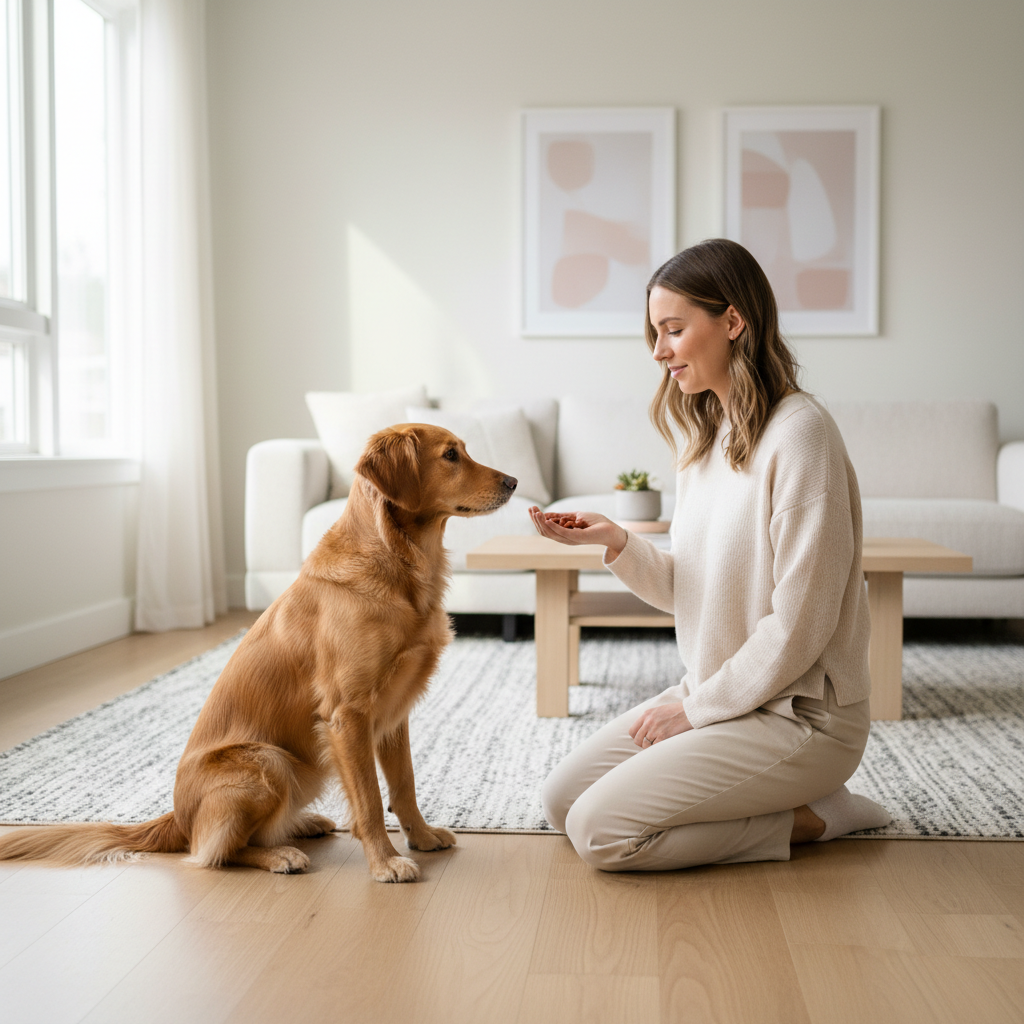
The goal is not just “keep them off,” it is teaching a clear alternative that works everywhere: what to do instead, when it pays, and what happens when it doesn’t. Once your dog understands that, you stop policing and start living normally again.
Why dogs jump on furniture (and what keeps it happening)
Most furniture jumping comes down to reinforcement, something about the couch or bed is rewarding enough that your dog keeps choosing it. That reward can be physical, emotional, or social.
- Comfort and warmth: soft cushions, blankets, sunny window spots.
- Access and attention: they can get closer to you, your face, your hands, your snack.
- Stress relief: some dogs self-soothe by nesting, digging, or perching.
- Inconsistent rules: “sometimes yes” teaches persistence, many dogs learn to try harder.
- Accidental rewards: you laugh, pet, talk, or physically lift them down, attention still counts.
According to the American Veterinary Society of Animal Behavior (AVSAB), reward-based training helps change behavior effectively while supporting animal welfare. In plain terms, if the dog keeps getting paid, the behavior keeps showing up.
Quick self-check: what situation are you really dealing with?
Before you pick a plan, figure out what “jumping on furniture” means in your house, because the fix for a bored adolescent is not the same as an anxious dog glued to your bed.
- Only when you’re home: often attention-seeking or habit around routines.
- Only when you’re gone: could be comfort-seeking, separation stress, or just easier access to a window.
- Only certain furniture: one couch might be near the door, near food, or near a sunny spot.
- They jump up, then guard it: treat as a safety issue, manage and get professional help.
- Puppy or small dog can’t get down safely: focus on safety and ramps, not just rules.
If you’re seeing growling, snapping, or stiff “don’t come closer” body language, skip the DIY battle and jump to the professional-help section. That is not a willpower problem.
Pick your rule: “never” vs “invited only” (write it down)
People get stuck here because the household is split: one person loves couch cuddles, another person hates fur. You can still train it, but you need one clear policy.
- Never on furniture: simplest for dogs to understand, easiest for consistency.
- Only with permission: doable, but you must teach an “up” cue and an “off” cue, and you must enforce the default of four paws on the floor.
Also decide what counts as furniture. Many dogs think the ottoman is a loophole, and honestly, they’re not wrong.
Core training: teach an alternative that beats the couch
To learn how to train a dog not to jump in a way that sticks, you need an “instead” behavior that is easy, rewarding, and repeatable. Two classics work in most homes: Go to Mat and Four on the Floor.
Option A: “Go to Mat” (the practical favorite)
This turns “don’t” into “do this.” You’ll use a bed, mat, or towel that can move room to room.
- Place the mat 3–6 feet from the furniture.
- When your dog steps on it, mark the moment with “yes” or a click, then reward on the mat.
- Feed 3–5 treats in a row while they stay there, then release with “all done.”
- Add the cue “mat” only after they start moving to it reliably.
- Slowly increase distance and distractions, including you sitting on the couch.
What you’re building is a default: couch time for you equals mat time for them, and that feels normal.
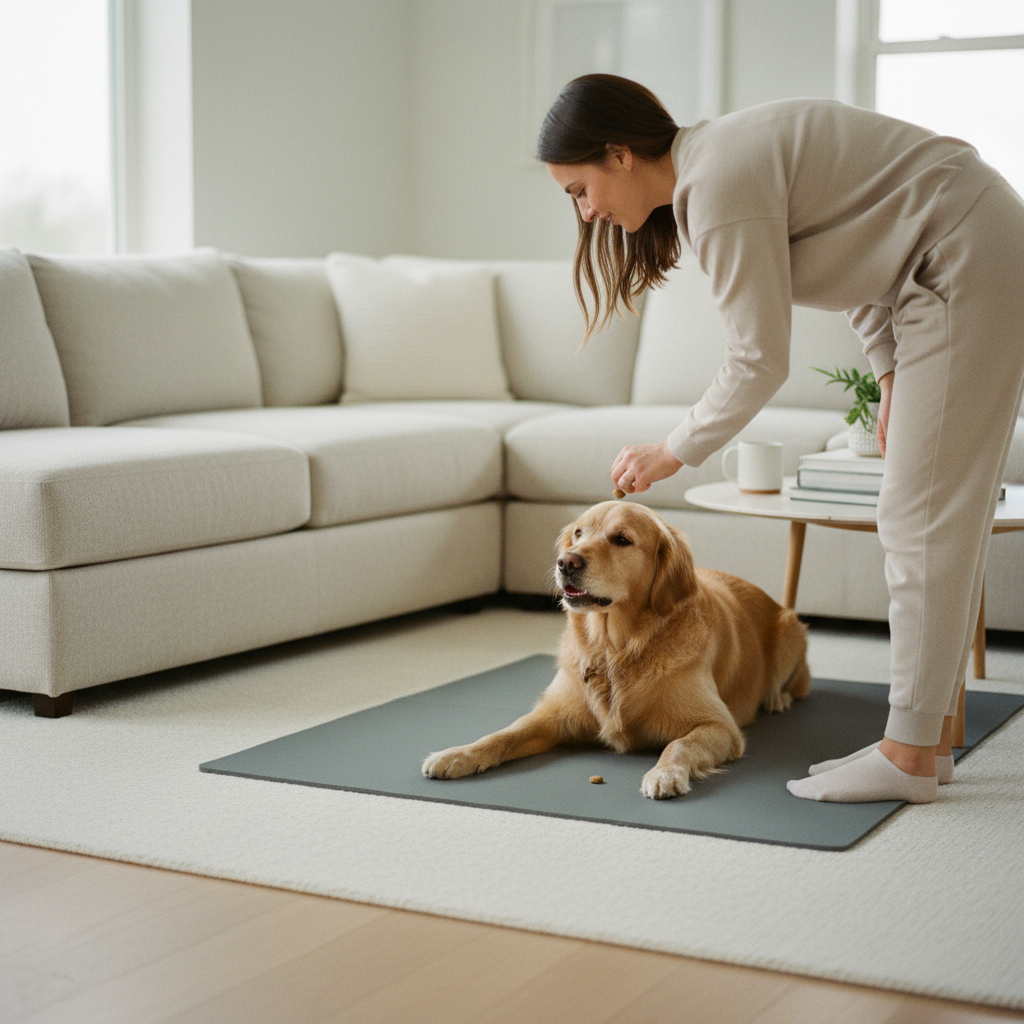
Option B: “Four on the Floor” (for greeting and impulse control)
If your dog launches onto the couch the second you sit down, reinforce the floor like it is the VIP section.
- Stand or sit near the furniture, keep treats ready.
- Reward when your dog is on the floor, before they jump.
- If they jump up, calmly guide them off with minimal talk, then reward the floor the moment paws hit down.
- Repeat short sessions, 1–3 minutes, several times daily.
This feels repetitive, because it is, but it’s also clean information for the dog: floor earns, couch doesn’t.
Management that makes training faster (not “cheating”)
Training fails when the dog keeps practicing the old behavior all day. Management prevents rehearsals while your cues get strong.
- Block access: baby gates, closing doors, or an exercise pen during unsupervised time.
- Change the picture: flip couch cushions up, add an upside-down laundry basket, or use couch covers that remove the “comfy reward.”
- Provide a better spot: a supportive dog bed near you often reduces the urge to climb up.
- Use a leash indoors: for a week or two, it can help you redirect smoothly without chasing.
According to the American Kennel Club (AKC), consistency and setting the environment up for success are key parts of effective training. That matches what most trainers see day to day.
A simple 2-week plan you can actually follow
If you’re tired of half-starting and quitting, follow one track for 14 days. Keep sessions short, keep it predictable.
| Day range | What you practice | What you manage | What “success” looks like |
|---|---|---|---|
| 1–3 | Mat game near furniture, 3–5 mini sessions/day | Block couch when unsupervised | Dog moves to mat with a lure or toss |
| 4–7 | Add cue “mat,” reward longer stays | Leash on in living room if needed | Dog stays on mat while you sit briefly |
| 8–11 | Increase distractions: you eat, stand up, sit down | Covers or cushion flip if couch is too tempting | Dog chooses mat without prompting sometimes |
| 12–14 | Real life reps: guests, TV time, evening routine | Remove barriers only when you can supervise | Fewer jump attempts, faster recovery to floor/mat |
One note, if your dog has a big burst of “trying harder” around days 3–6, that can be normal. Many behaviors spike briefly when the old payoff disappears.
Common mistakes that keep the problem alive
Most people do not fail because they lack love, they fail because the dog keeps getting mixed messages or the reward timing is off by a second.
- Talking too much: “off, off, off” becomes background noise, show the rule through outcomes.
- Rewarding after the jump: if you lure them down with a treat every time, some dogs learn “jump up to start the snack routine.” Reward the floor, not the climb.
- Punishing or scaring: yelling or physical corrections can increase stress and sometimes worsen guarding.
- Inconsistent permissions: one cuddle invite can undo a week if your dog cannot predict when it’s allowed.
If you want “invited only,” make the invitation obvious and rare at first, then build from there.
When you should bring in a professional
Some furniture issues are really safety or anxiety issues wearing a “bad manners” costume, and you do not need to solve that alone.
- Resource guarding: growling, snapping, freezing, or hard stares when approached on furniture.
- Separation anxiety signs: distress vocalizing, destructive exits, drooling, or panic when left alone, consult a veterinarian or qualified behavior professional.
- Pain or mobility changes: sudden couch obsession or refusal to get down can be discomfort, a vet check is a smart next step.
According to the American College of Veterinary Behaviorists (ACVB), behavior problems can have medical and emotional components, and individualized plans matter. Many cases move faster with a certified trainer using reward-based methods.
Key takeaways (so you don’t overthink it)
- Stop the practice: management is part of training, not a separate thing.
- Teach a replacement: mat and floor behaviors are easier to reinforce than “don’t.”
- Pay the right moment: reward before the jump, and immediately when paws return to the floor.
- Consistency beats intensity: short daily reps outperform one long weekend session.
If you start today, pick one rule for the whole household, set up a mat near the couch, and run three tiny sessions. That alone usually changes the vibe in the room, and it gives your dog a clear way to win without climbing the furniture.

Action step: Choose either “never” or “invited only,” then commit for two weeks. If you hit guarding, panic behaviors, or a sudden change that might involve pain, get help sooner rather than later.