
how to stop cat from meowing at night starts with a simple truth, your cat usually isn’t “being bad,” they’re communicating a need, a habit, or discomfort that shows up when the house gets quiet.
If you’re exhausted, you’re not alone, night vocalizing is one of the most common “I can’t sleep” cat complaints, and it often turns into an accidental training loop where meowing gets attention, food, or a door opened.
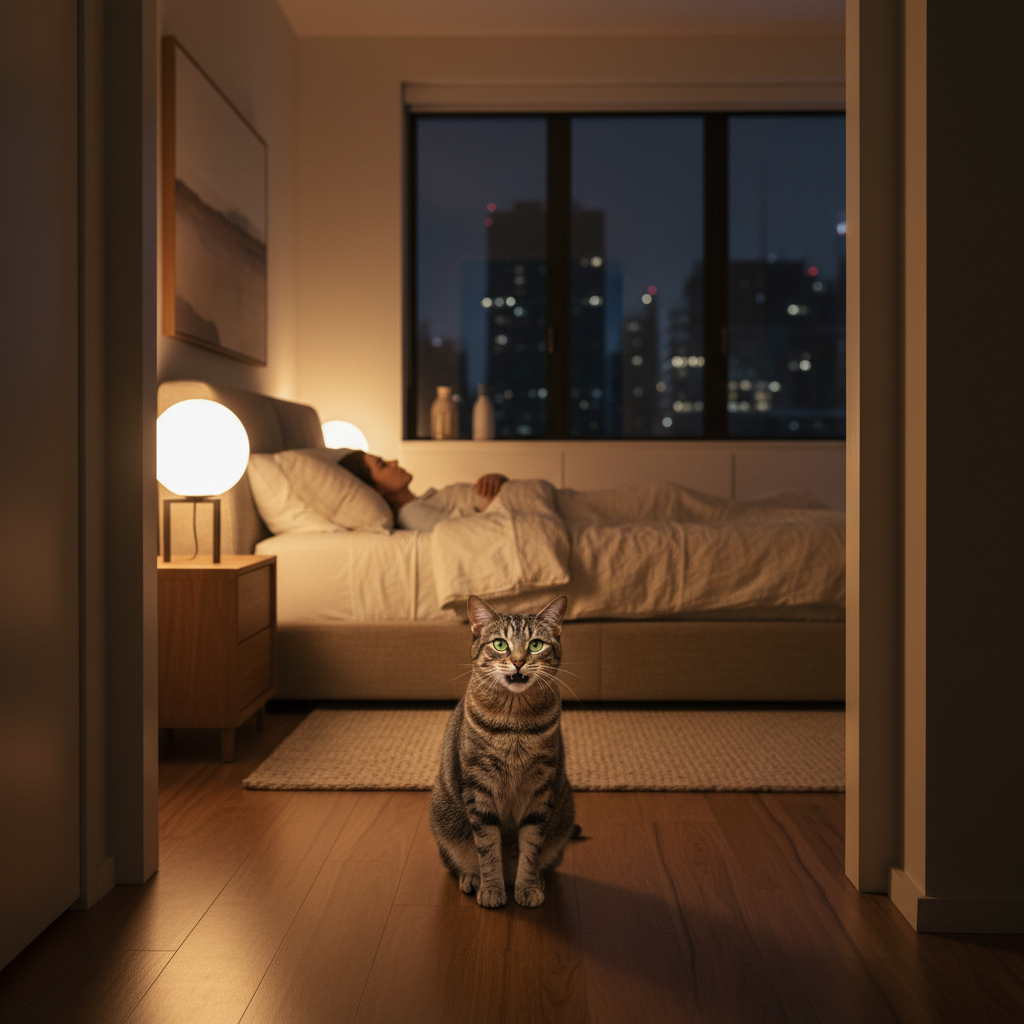
The good news is that many cases improve with a few targeted changes, feeding timing, play, sleep cues, and how you respond. The key is matching the fix to the cause, because “ignore it” works in some homes and backfires in others.
Why cats meow at night (the causes that actually matter)
Night meowing usually falls into a handful of buckets. Figuring out which bucket you’re in saves a lot of trial and error.
- Attention-seeking habit: the cat learned that noise leads to a human reaction, even “shhh” counts as attention.
- Hunger or food schedule mismatch: a long gap between dinner and breakfast can trigger early-morning demands.
- Boredom and excess energy: common in young cats, indoor-only cats, and cats without predictable play time.
- Stress, territory changes, or anxiety: moving, new pets, schedule changes, outside cats at the window, even a new scent.
- Age-related confusion: some senior cats vocalize more at night, especially if vision or hearing declines.
- Medical discomfort: pain, GI issues, hyperthyroidism, urinary problems, cognitive dysfunction in older cats, among others.
According to the American Veterinary Medical Association (AVMA), behavior changes can be associated with health issues, so persistent or sudden night vocalizing deserves a health check, especially in older cats.
Quick self-check: which night-meowing pattern is yours?
Use this as a fast filter. You don’t need a perfect diagnosis, just a direction.
- Meowing starts around 3–5 a.m. near the kitchen: likely food-driven or routine-driven.
- Meowing at your door, stops when you get up: likely attention or access-driven.
- Zoomies + meowing after you go to bed: likely under-stimulated or poorly timed play.
- Meowing at windows, growling, pacing: likely outside triggers or territorial stress.
- New behavior, louder than usual, paired with litter box changes, vomiting, weight loss, drinking more: possible medical issue, don’t wait it out.
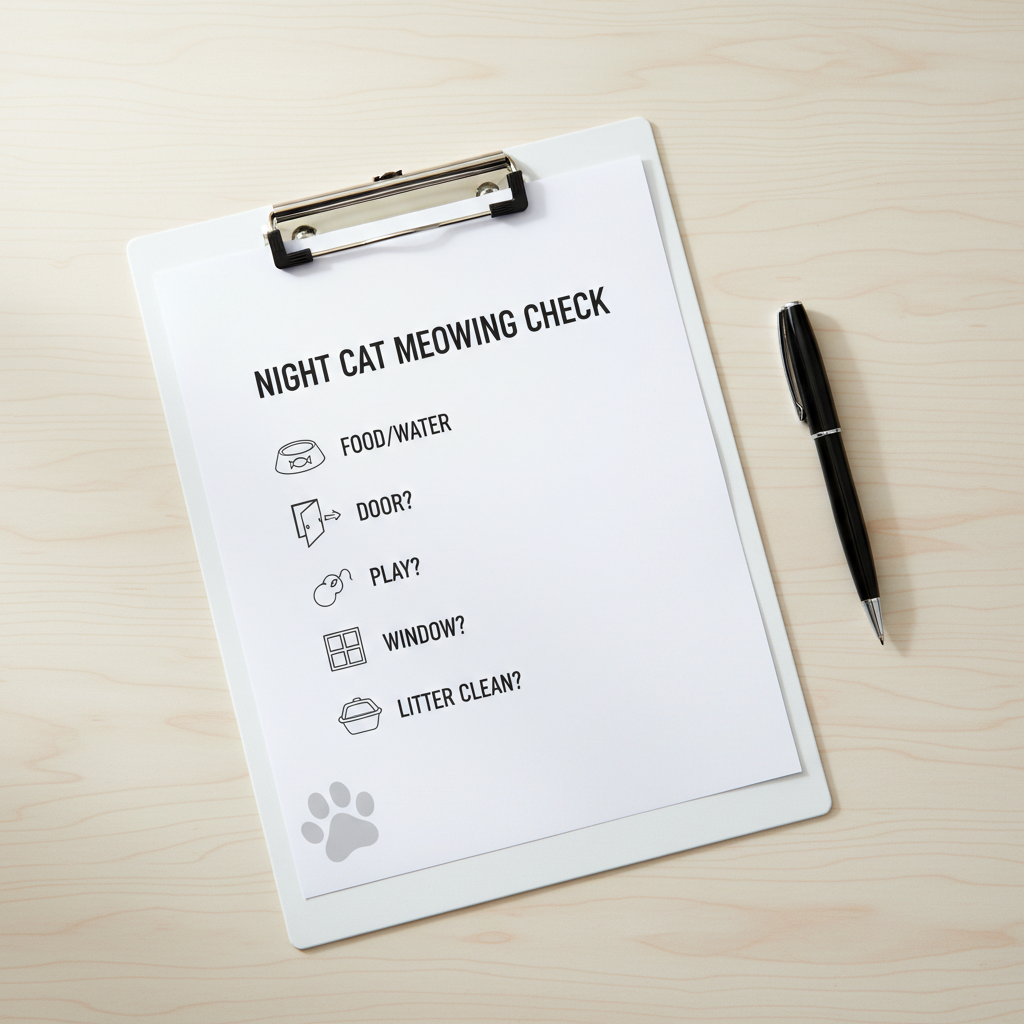
If you’re stuck between two patterns, that’s normal. Many cats meow for a mix of hunger, habit, and “I’m awake, why aren’t you?”
Rule out health and safety issues early (especially for seniors)
If you want the shortest path to results, don’t skip this. Night crying that’s sudden, intense, or paired with other changes should be treated as a possible health signal, not a training problem.
- Book a vet visit if the meowing is new, escalated, or your cat is 8+ and behavior shifted quickly.
- Track 3 days of appetite, water intake, litter box output, and weight if you can do it safely.
- Scan for pain hints like hiding, stiffness, jumping less, sensitivity when touched.
According to the American Association of Feline Practitioners (AAFP), routine wellness care and early assessment help catch medical contributors behind behavior changes. If your cat seems distressed or you notice urinary straining, it’s safer to contact a veterinarian promptly.
Reset the routine: a realistic evening plan that reduces night meowing
Most households get better results from structure than from gadgets. The aim is to shift your cat’s most active, hungry window to earlier in the evening.
A simple “hunt, eat, groom, sleep” sequence
- 10–15 minutes of interactive play (wand toy, chase, short sprints), stop while your cat still wants more.
- Small meal right after play, this often taps into natural rhythms and encourages settling.
- Calm wind-down in a predictable spot, dim lights, minimal talking, no rough play.
If you’re aiming for how to stop cat from meowing at night, consistency matters more than intensity. Three solid nights per week beats one “perfect” night followed by chaos.
Stop reinforcing the meow: what to do when it happens at 2 a.m.
This is the part people hate, because it’s inconvenient and emotionally messy. But if your cat learned that meowing opens doors or produces snacks, you have to change the payoff.
What usually works (without being cruel)
- Don’t reward the meow with food, not even “just this once,” because that “once” is the lesson.
- Keep responses boring if you must respond, quiet, minimal eye contact, no chatting.
- Reward the quiet in the daytime and evening, attention and treats when your cat is calm.
- Use a pre-emptive plan, set an automatic feeder for early morning if hunger is a driver, so you’re removed from the transaction.
Expect a short-term spike. Many cats try harder for a few nights when the old trick stops working. If you cave during the spike, the behavior tends to lock in stronger.
Environment fixes that help you sleep (and keep your cat busy)
Some cats meow because nights are understimulating or stressful. Small environment tweaks can take the edge off.
- Night-safe enrichment: puzzle feeders, treat balls, a few rotated toys that appear only at night.
- Window management: block views if outdoor cats trigger vocalizing, or use frosted film at cat height.
- Comfort station: bed, water, litter box access, and a “legal” scratch spot in a quiet area.
- Sound and light cues: white noise can mask minor sounds, a dim nightlight can help some seniors navigate.
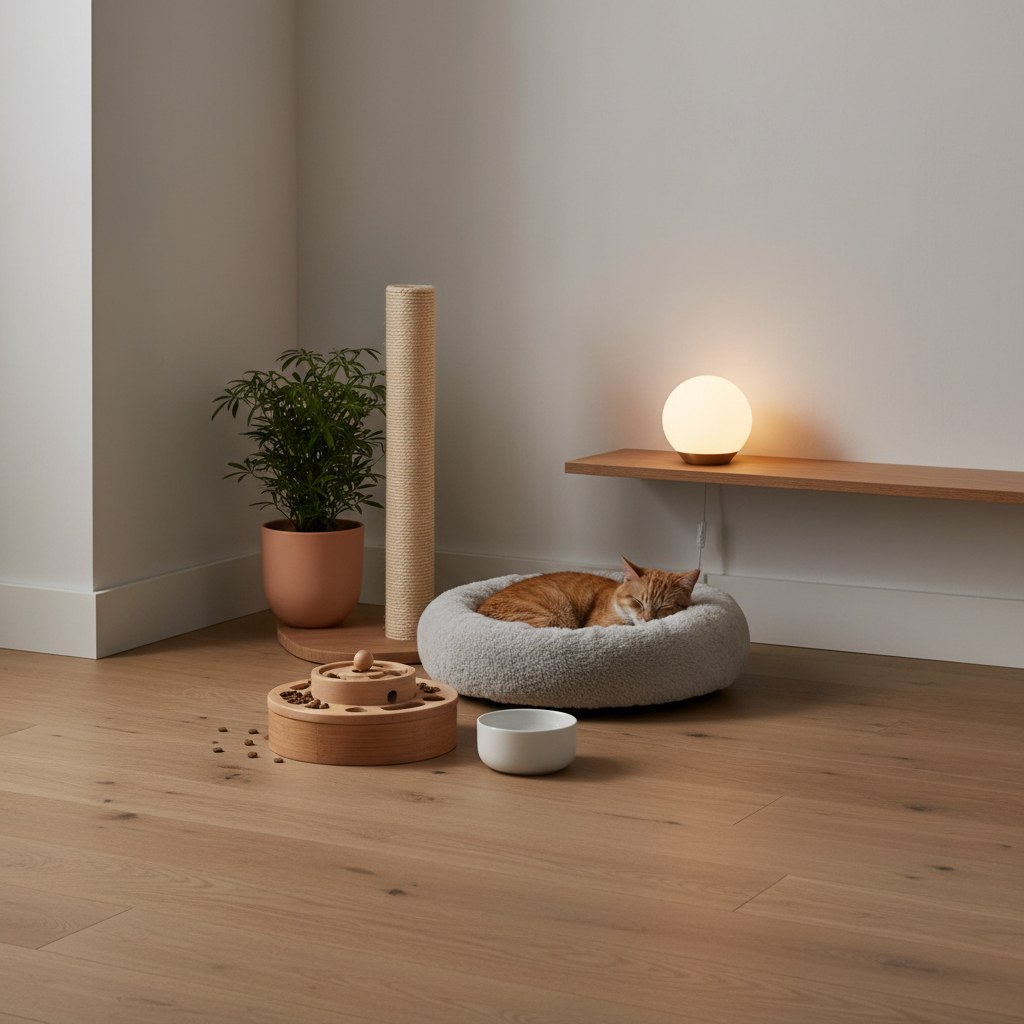
If your cat scratches and meows at the closed bedroom door, consider whether you want to solve “access” or “noise.” Some households do better letting the cat in with boundaries, others sleep better with a firm closed-door plan plus enrichment outside.
Pick the right strategy for your situation (comparison table)
Here’s a practical way to choose tactics without trying everything at once.
| Likely trigger | What it looks like | What to try first | What to avoid |
|---|---|---|---|
| Food-driven | Meows near kitchen, early morning timing | Later dinner, small bedtime meal, timed feeder | Feeding on demand at night |
| Attention habit | Stops when you talk, pet, or get up | Ignore + reward quiet, consistent boundary | Scolding, chasing, “just once” cuddles at 3 a.m. |
| Energy/boredom | Zoomies, playful biting, restless pacing | Interactive play + post-play meal | Laser-only play with no “catch” finish |
| Stress/territory | Window watching, yowling, new triggers | Block triggers, add safe spaces, calming routine | Forcing interaction when cat is amped up |
| Possible medical | Sudden change, senior cat, other symptoms | Vet check, symptom log, gentle environment support | Assuming it’s “just behavior” for weeks |
Common mistakes that keep the problem going
A few well-meaning moves can prolong night vocalizing. If any of these sound familiar, you’ve got an easy lever to pull.
- Talking to your cat through the door, it feels like soothing, but often reads as success.
- Free-feeding that runs out overnight, the empty bowl becomes a 4 a.m. emergency.
- Doing big play sessions only at random, unpredictability can keep some cats on alert.
- Punishment tactics like spraying water or yelling, these may increase anxiety and can damage trust.
- Changing five things at once, you can’t tell what helped, and your cat may feel unsettled.
If you’ve been trying how to stop cat from meowing at night for a while, the most common “hidden” issue is mixed signals, quiet enforcement on weekdays and exceptions on weekends.
Key takeaways and a 7-day action plan
You don’t need perfection, you need a plan you’ll actually follow when you’re tired.
- Day 1–2: rule out red flags, set up a symptom log, book a vet visit if anything looks off.
- Day 3–4: start the evening play-then-meal routine, keep bedtime calm and predictable.
- Day 5–7: remove night rewards, use timed feeding if hunger drives the pattern, add night-safe enrichment.
Conclusion: Most night meowing improves when you match the fix to the cause and stop accidental reinforcement. If the behavior is sudden, intense, or your cat is older, prioritize a veterinary conversation while you adjust the routine at home.
If you want one next step tonight, pick one change you can keep for a full week, either the play-then-meal sequence or removing night feeding rewards, then reassess.
If you’d rather not troubleshoot alone, a veterinarian or a qualified feline behavior professional can help you narrow the cause faster and build a plan that fits your household rhythm, especially when sleep deprivation makes consistency hard.
FAQ
How long does it take to stop a cat from meowing at night?
Many households notice improvement within a week or two once the routine is consistent, but if the meowing has been rewarded for months, it can take longer. A short “it got worse first” phase is common when you stop reinforcing it.
Is it okay to ignore my cat meowing at night?
Ignoring can work when the cause is attention-seeking and your cat is otherwise healthy and safe. If you see signs of illness, litter box trouble, or distress, ignoring is a poor fit and a vet call makes more sense.
Should I feed my cat when they meow at 3 a.m.?
Usually no, because it teaches a clean cause-and-effect. If hunger timing is the issue, a timed feeder or a later bedtime snack often solves it without turning you into the “night buffet.”
My cat only meows at night, not during the day, why?
Night is quieter, your attention is less available, and small triggers like outdoor animals become more noticeable. Some cats also shift their active hours if daytime is low-stimulation or they nap all afternoon.
Can cat litter box problems cause night meowing?
They can. Discomfort, urgency, or avoiding the box may show up as pacing and vocalizing, and urinary issues can be serious. If you notice straining, frequent trips, or accidents, it’s safer to contact a veterinarian promptly.
Do calming pheromone diffusers help with night vocalizing?
They help in some stress-driven cases, especially when the trigger is environmental or territorial. They’re not a standalone fix for hunger or attention habits, but they can make behavior work easier.
What if my senior cat yowls at night?
For seniors, prioritize a medical evaluation because pain, thyroid issues, and cognitive changes are all possibilities. At home, a nightlight, easy access to water and litter, and a predictable bedtime routine often reduce confusion-driven vocalizing.
Will letting my cat sleep in my bedroom stop the meowing?
Sometimes, especially if the driver is separation or door-related frustration, but it can also introduce new sleep disruptions. If you try it, set boundaries early, like no feeding in the bedroom and a calm bedtime routine.